Published by: Structural Engineering & B2B Packaging Team (Collapsible Rigid Boxes Experts)
Reading Time: 10 mins
【Key Takeaways】
How much does a custom rigid box cost? At our factory, a mid-size box (around 20 × 15 × 6 cm) usually costs $1.20–$3.00 per unit at 1,000 pcs and $0.85–$2.30 at 5,000 pcs. Larger or more complex boxes can cost more. Quantity, structure and box size decide most of the custom rigid box cost, while finishes and inserts usually add less than buyers expect.
The biggest savings come from choosing the right board thickness, not stacking too many finishes on one box, and using a collapsible structure for long-distance shipping. A collapsible box costs more per unit, but because it ships flat, it can greatly reduce freight and lower your total landed cost.
Why this guide is worth your time: Most pricing articles stop at size, quantity and finishes. This one also covers the unspoken rules we see every day on the factory floor: the hidden differences that rarely appear in a quote but decide whether an order goes smoothly. If you buy custom packaging from China, read it to the end. It may help you make a smarter sourcing decision on your next order.
Why rigid box quotes vary so much
Ask five suppliers to quote the same rigid box and you will often get five very different numbers. Part of the gap shows up on paper and is easy to compare. The bigger part is hidden: it only appears when you hold the samples side by side, or see the factory’s machines and processes for yourself.
Hidden differences: what a spec sheet won’t tell you
1. Raw material grade. Two boards with the same 1.5 mm thickness can be very different products. Greyboard and wrapping paper come in A, B and C grades, and brands vary too. At the same thickness, A-grade board is stiffer and more consistent, and usually meets stricter environmental standards. It is also the most important single factor in preventing warping, as we explained in Why Rigid Gift Boxes Warp After 1–2 Months and How to Prevent It.
2. Quality management. A factory with a working quality system prevents the most painful problems: wrong materials, wrong specifications, print defects and mixed-up orders. That protection is worth far more than a small saving on unit price. But a certificate alone does not prove it. An ISO 9001 certificate is easy to obtain; making every worker follow the process every day is not. In our experience, the real signals show up in conversation: how clearly the team communicates, how carefully they confirm each order detail, and whether they are willing to write quality commitments into the contract.
3. Machines and production environment. A very low quote has to save money somewhere. Often it is in older, smaller machines that cause uneven printing and rough cut edges, thin supervision on the production line, less-trained workers, or poor storage that lets board absorb moisture. Each of these cuts cost, and each shows up later as a quality problem.
This is also why good trading companies exist. The best ones know both the product and how factories really operate, stay close to production, and enforce controls a remote buyer cannot. Because they place a large volume of orders, many factories depend on them, and they can often secure better prices than a buyer coming to China to find a factory alone. That is only part of the picture, and it is not an excuse for every trader, but it reflects real problems buyers face in this market. Whether you buy direct or through an agent, what matters is that someone is actively controlling quality on the ground.
4. The signal a price-only buyer sends. Suppliers receive dozens of inquiries a day and quickly read what each buyer cares about. A buyer who negotiates only on price signals that price matters more than quality, and suppliers tend to respond with the same priorities. A skilled buyer and a skilled sales contact both take responsibility for the order. The best results come when both sides discuss quality standards as seriously as price.
Visible differences: easy to check if you ask
Board thickness and weight. Some suppliers substitute high-bulk, lower-density board for full-weight board, or hide under-weight board inside thickness tolerances. It is a real risk, but easy to catch: ask for the board grade and weight in writing, and compare samples side by side.
Samples and tooling. Whether a quote includes the sample fee and tooling is simple to confirm upfront.
Trade terms. EXW, FOB and DDP quotes cover very different things. Agree on the same trade term before comparing prices.
The visible items are covered in detail in Part III below. The hidden ones are the reason the cheapest quote is rarely the lowest total cost.
Part I. Rigid box prices by style and quantity
The table below shows our typical unit prices for a mid-size box around L20 × W15 × H6 cm, 1.5 mm greyboard, CMYK printed art paper wrap and one finish such as matte lamination. Prices are FOB Shenzhen in USD per unit.
| Box style | 500 pcs | 1,000 pcs | 3,000 pcs | 5,000 pcs |
|---|---|---|---|---|
| Lid-and-base (two-piece) | $1.50–$2.10 | $1.20–$1.60 | $0.95–$1.30 | $0.85–$1.20 |
| Drawer (sleeve and tray) | $1.60–$2.20 | $1.30–$1.80 | $1.05–$1.45 | $0.95–$1.30 |
| Magnetic closure (book style) | $1.90–$2.70 | $1.60–$2.30 | $1.35–$1.90 | $1.25–$1.75 |
| Collapsible magnetic | $2.50–$3.70 | $2.10–$3.00 | $1.75–$2.50 | $1.60–$2.30 |
Our standard MOQ is 500 pcs. The biggest price drop usually happens between 500 and 3,000 pcs, because setup work such as cutting dies, printing plates and machine adjustment is spread over more units. Above 5,000 pcs, savings continue but more slowly, because most of the remaining cost is material and hand labour.
Part II. 7 factors that drive custom rigid box cost
1. Order quantity. This is the single biggest lever. Setup costs are fixed, so they weigh heavily on small runs and almost disappear on large ones. See our MOQ guide for what to expect on a first order.
2. Box structure. A simple lid-and-base box is the most economical. Magnetic closures add magnets, a hinge wrap and more hand assembly, typically +$0.4– $0.6. Drawer boxes and multi-compartment presentation boxes sit higher again.
3. Box size. Larger panels need more board, more wrapping paper and more labour. Size also affects how many boxes fit per carton, which feeds straight into freight cost.
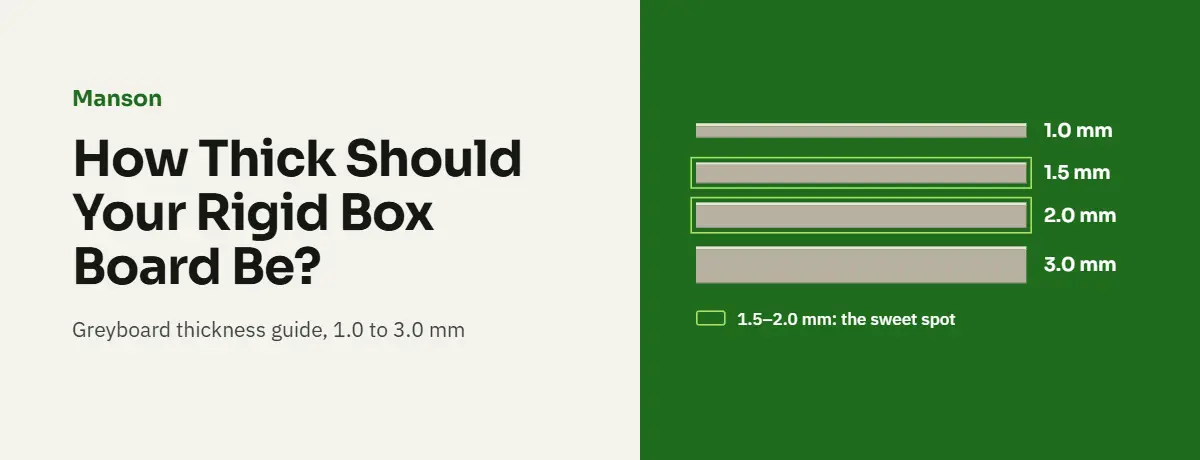
4. Greyboard thickness. Most gift boxes work well at 1.5–2.0 mm. Going to 2.5–3.0 mm adds material cost and slows wrapping, so only specify it for heavy products or large formats. Our greyboard thickness guide explains how to choose.
5. Wrapping material. Standard printed art paper is the baseline. Specialty papers, textured stocks, fabric or leatherette wraps can add $0.15-$0.3 per box.
6. Finishes. Each finish is a separate process: matte or soft-touch lamination, hot foil stamping, embossing, debossing, spot UV. One or two finishes are usually enough. Stacking four or five on one box adds cost without adding much to perceived quality.
7. Inserts. Paper or cardboard inserts are the most cost-effective and keep the box plastic-free. EVA foam, flocked trays or custom-cut inserts add +$0.2–$0.5 depending on complexity.
Part III. Hidden costs buyers often miss
The unit price is only part of the real custom rigid box cost you pay. Before comparing quotes, check whether each one includes the items below.
|
Cost item |
What it covers |
Our typical policy |
|---|---|---|
|
Sample fee |
A physical pre-production sample with your artwork |
USD$60-$120, Refundable on bulk orders (see FAQ) |
|
Tooling |
Cutting dies and printing plates |
[Included [One-Time Use] |
|
Artwork and structure design |
Dieline creation, structural engineering |
Free structural design [ Free ] |
|
Packing |
Master cartons, protection film, pallets |
[Included] |
|
Freight and duties |
Sea or air freight, customs clearance, import duty |
Depends on trade term [ Below ] |
When comparing quotes, always check the trade terms (Incoterms®) first, as they can make two prices look very different. EXW means you collect the goods from our factory and handle everything after that, including export clearance. FOB includes export clearance and loading onto the vessel at the departure port. DDP includes freight, customs clearance and import duties, all the way to your door.
A DDP quote will always look higher than an FOB quote for the same box, because it covers far more. If you’re comparing suppliers, make sure you’re comparing the same terms. Most of our buyers choose DDP because it’s the easiest option: you simply pay and wait for delivery, while we handle everything from production to shipping, with one single point of contact from start to finish.
About freight estimates: Most buyers need an estimate of the total landed cost before placing an order. However, any freight quote given before the goods are packed is only an estimate. Once production is finished, the final carton size and weight may differ slightly from the original calculation, and freight rates also change depending on when the goods ship. This is completely normal.
For this reason, the freight in a supplier’s quotation should be treated as a reference. A reliable supplier will recalculate the actual freight after production and confirm it with the buyer before shipment, so there are no surprises later. This is one of the most common sources of disputes for first-time buyers sourcing from China, which is why it is worth clarifying at the quotation stage.
Freight is where box structure matters most. Collapsible rigid boxes ship flat, which in our tests cut shipping volume by up to 75% compared with classic assembled boxes.
Part IV. How to lower cost without making the box look cheap
- Specify the right board, not the thickest. A well-made 2 mm box often looks and feels as premium as a 2.5 mm one, and it stays flatter if the board, glue and paper are balanced. See why rigid boxes warp.
- Choose collapsible for long-distance shipping. Flat-packed boxes cut freight and warehouse space. For overseas orders, the freight saving can outweigh the slightly higher unit price.
- Limit finishes to one or two. A clean soft-touch lamination with a single foil logo usually reads as more premium than a box covered in effects.
- Share sizes across SKUs. If several products can use the same box size with different inserts or printing, you combine quantities and reach a lower price tier. Insert MOQ for EVA/Sponge: 500pcs/SKU, Cardboard / Corrugated paper insert can be lesser qty, contact our customer service to quote base on specific size and structure.
- Order closer to your real annual volume. Splitting a year’s demand into small repeated orders means paying setup costs again each time.
- Use paper inserts where possible. They cost less than foam, keep the box mono-material, and help with EU PPWR requirements.
A real quote, broken down
Here is how one recent order was priced. Client details are anonymised. Order: 30,000 magnetic closure boxes for a US skincare brand, 28 × 16 × 12 cm, 2 mm greyboard, CMYK printing, Matt lamination EXW price.
| Cost component | Per unit (USD) | Order total (USD) | Share of cost |
|---|---|---|---|
| Greyboard + V-grooving + labor + board cutting | 0.340 | 10,200 | 26.6% |
| Folding + glue + assembly + machine setup | 0.250 | 7,500 | 19.5% |
| Art paper + printing + lamination + wastage | 0.190 | 5,700 | 14.8% |
| Magnets + labor + machine cost + wastage | 0.150 | 4,500 | 11.7% |
| Factory overhead (energy, depreciation, administration) | 0.125 | 3,750 | 9.8% |
| QC + packing + export cartons | 0.105 | 3,150 | 8.2% |
| Hot foil + foil plate + labor + machine cost + wastage | 0.060 | 1,800 | 4.7% |
| Double-sided tape + manual labor + wastage | 0.060 | 1,800 | 4.7% |
| Total production cost | 1.280 | 38,400 | 100% |
At 30,000 pcs, the greyboard structure was the largest single cost, at about USD 0.34 per unit or 27% of the total, followed by folding and assembly at around 20%. Each line here includes its own materials, labor, machine time and wastage, which is how most factories actually calculate the cost of a rigid box.
The gold foil logo added only about USD 0.06 per unit, under 5% of the total, including the foil plate, labor, machine time and wastage. Machine setup and printing plates, which weigh heavily on small orders, were spread so thinly at this volume that they became almost invisible in the total. Because the boxes ship flat, a full order of 30,000 fits into a single container, which keeps the buyer’s freight cost low.
FAQ
Why are custom rigid boxes more expensive than folding cartons? Rigid boxes use thick greyboard wrapped by hand or semi-automatically in printed paper. That means more material and far more labour per box. In return they feel heavier, protect better and are reused by customers.
Why do quotes from different Chinese factories differ so much? Partly because they assume different board thickness, materials, finishes or trade terms. But the bigger differences are often hidden: raw material grade, quality management, and the machines and production environment behind the quote. Ask every supplier to quote the same specification and trade term, then compare samples side by side.
Is the sample fee refunded? Yes, the sample fee is credited against your mass production order. for order qty below 500pcs we refund 50% sample fee. For order qty equal or above 1000pcs we refund full sample cost to client’s bulk order]
Does the price include shipping? Only if the quote is DDP. FOB and EXW quotes exclude international freight and import duties. We can quote both so you can compare.
What is the cheapest rigid box option? A lid-and-base box in 1.5 mm board with standard printed paper and one finish, ordered at 3,000 pcs or more.
How long does production take? Our standard lead time is about 15 business days after sample approval, depending on structure, quantity and season.
Get an accurate custom rigid box cost for your project
The fastest way to a reliable price is a clear specification. Send us your box size (or product size), quantity, preferred style, artwork if ready, and destination market. Our structural engineering team will recommend a specification, quote both FOB and DDP, and prepare a sample for you to test.